Articles of Combination
A Bull. A Bear. A Pig. is a draw-poker-like game played with the true annual accounts of publicly traded companies, as filed with the Securities and Exchange Commission. It is free, requires no account, and settles its own arguments.
1.00 — Objectives
1.01 The objective of each player is to assemble the finest combination — nine concerns whose combined accounts best satisfy the Rule in force.
2.00 — The Deck
2.01 Every card bears a company's accounts for its latest complete fiscal year, as filed: revenue, operating income, net income, cash from operations, capital spending, research, dividends, buybacks, assets, cash, and debt. Three decks are sanctioned: The Big Board (every concern); Blue Chips (the thirty largest by public float); and The Curb (everyone else). Five era decks follow the founding of the concern: Gilded Age (before 1900), Interwar, Postwar, Reagan Era, and Dot-Com & After.
Rule 2.01 Comment: A founding date is a matter of company legend, not of filing. The Committee records the conventional date and declines to referee the Delaware paperwork.
2.03 Card fronts are blind: the concern, its ticker, and its sector, nothing more. The books are on the back, and a look costs five bucks, charged to the book on sight; a concern once opened stays open for the hand, traded away or not. After judgment the books of the nine are opened free of charge.
Rule 2.03 Comment: Diligence has always cost money. The Committee merely posts the price.
2.02 Each card shows the ticker over its stat fingerprint — a twelve-ray figure drawn from the accounts themselves. No logo, trademark, or likeness appears on any card; sector colors only.
3.00 — The Deal and the Rounds
3.01 Each hand begins with nine concerns, dealt face up. 3.02 Three sessions follow, strictly descending, and they are the trading day: The Open, in which you may divest as many as three concerns; Midday, two; and The Close, one last trade before the bell. Replacements come off the tape. 3.03 A player may cash out at any time, forfeiting all remaining rounds and filing the nine as held.
3.04 The nine held when the rounds end are the combination. There is no discard, no spin-off, and no further selection of any kind.
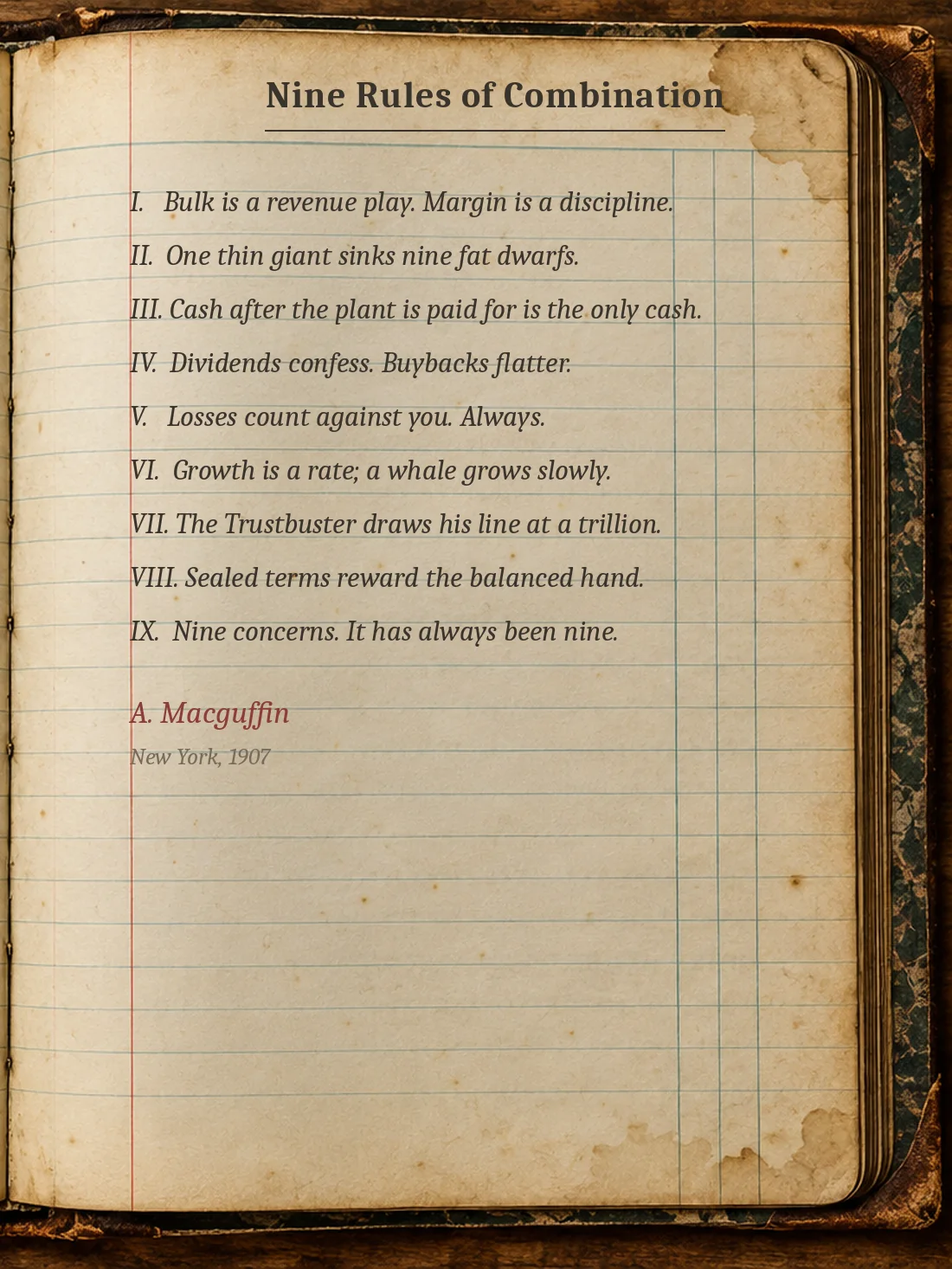
Rule 3.04 Comment: A combination is nine concerns. It has always been nine concerns.
4.00 — Judgment
4.01 Every hand is a day on the Street, and it is judged once, at the Close, under one of two rules posted during the day. At the Open the deal announces a long rule — the Bull: Top Line (most combined revenue), Fat Margin (highest combined operating margin), Bottom Line (most combined net income; losses count against you), Cash Machine (most combined free cash flow — cash from operations less capital spending; for banks and insurers, whose cash-flow statements are a matter of theology, net income stands in), Coupon Clippers (most combined dividends paid), Growth Story (highest combined year-over-year revenue growth), or Pigs Get Slaughtered (nearest the Trustbuster’s line without going over — the line is set for each deck at roughly what nine average concerns would bring, and is posted on the banner; exceed it and he breaks you up for nought). At Midday the tape turns and a short rule is announced — the Bear: Short Line (least combined revenue), Thin Margin (lowest combined operating margin), Red Ink (least combined net income), Cash Burn (least combined free cash flow), No Coupon (least combined dividends), or Stall (lowest combined growth). 4.01a The Close is sealed. When the nine are filed the bell rings bull or bear at even odds, and the nine are judged under whichever rule rang.
Rule 4.01a Comment: A balanced nine grades near fifty under either bell and books nothing. A hoarded nine books forty either way. The Committee does not advise; it merely observes that the Pig is the player who decides which, and when.
Rule 4.01 Comment: Fat Margin punishes greed. A seven-hundred-billion-dollar retailer is a great weight upon a margin, and the Committee has watched many a proud combination sink beneath one.
4.02 Your nine is graded against every possible nine in the deal — all 5,005 — and the grade is your percentile among them. Committee's Note. Of the 5,005, precisely 657 cannot be reached by any legal sequence of rounds; the judges grade against all of them regardless, holding that perfection is not obliged to be attainable. A grade of 100 is the one perfect combination. 4.03 Your nine sets of accounts are then combined into a bolt-on composite concern, and the judges name the real company it most resembles. This finding is advisory, unappealable, and the entire point.
4.04 A hand graded at the fiftieth percentile or better is a Bull; below it, a Bear; a hand that crosses the line is a Pig. 4.05 Every point above the fiftieth percentile is one buck — one million dollars — booked to your statement; every point below it is a buck off the book. A Pig hand is entered as bacon and costs fifty. A book may go underwater; an account may not. 4.06 A statement is five hands, all five played, and every statement begins fifty bucks in the hole: the call, a margin call due when the fifth hand is filed. Your book is five hands of trades, net of diligence; your balance is the book less the call. Clear it and you are in the black; fall short and you are in debt. Either way the balance goes to the account — once a day for the daily deal; a replay of the same deal is practice and is entered as such. Open Outcry deals are fresh every time and always count.
Rule 4.06 Comment: The Committee is aware that a desk which lends you fifty million before you have sat down is not how banks work. It is, however, how the Street has always worked.
4.08 A statement, once its first hand is filed, is owed. Leave it — by the door, by a new deal, or by closing the book — and the desk settles it as it stands: hands filed count, the rest are entered as nought, and the balance posts.
Rule 4.08 Comment: The Committee has noticed that players who may abandon bad statements finish only good ones. The Committee finds this uninteresting.
4.07 The account is a lifetime balance and carries a rank: Debtor below zero, Clerk at zero, then Junior Partner at a hundred million, Partner at two hundred fifty, Captain of Industry at five hundred, Billionaire at a yard, Titan at five, Robber Baron at ten, Old Money at a hundred, Trillionaire thereafter. Each is marked with a parade.
5.00 — Tender Matches
5.01 Two players is 9 Shares; three, 18; four, 27. 5.02 Every seat receives the identical deal and tape, sealed until all have played — the duplicate principle, borrowed from bridge and dressed in pinstripes. Luck is issued equally and is therefore no excuse.
5.03 Every seat books its own spread each round, exactly as in solo play; the round's best hand is credited a hand won. 5.04 A dead heat on a hand is a merger of equals: books still move, no hand is charged.
5.05 After five rounds the table is ranked by book, largest first, and the leader takes the table. 5.06 The Holding Company keeps your account against every opponent by name — sittings, wins, and dollars either way — and against every named table.
6.00 — Tender by Post
6.01 Matches may be conducted by correspondence, identified by a six-character wire code. Rounds stay sealed until every seat has played. 6.02 Only decisions travel the wire; scores are never transmitted — every device derives the standings by replay.
Rule 6.02 Comment: Under this construction a fabricated score is not forbidden. It is unexpressible, which the Committee regards as the superior prohibition.
7.00 — Challenge Links
7.01 A completed solo game compresses into a code of about seventy characters. A rival who opens it plays your identical deal against your ghost, grade for grade.
8.00 — The Judges
8.01 The Judges are deterministic: the same deal, from the same seed, is identical on every device on earth. The daily deal is one deal, shared by all. 8.02 The Judges keep no accounts, sell no notices, and call no third parties. The whole exchange is one file. 8.03 Nothing here is investment advice. The accounts are as filed; the combinations are yours.
9.00 — Lexicon
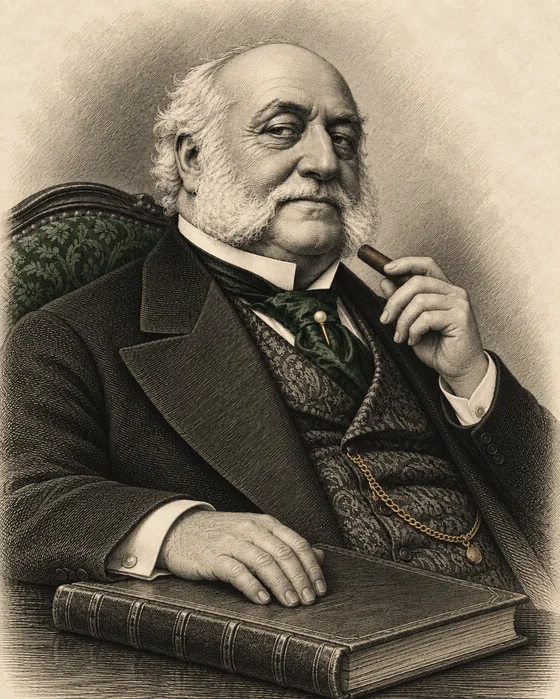
Buck — one million dollars; one point of spread. Yard — one billion. Spread — your percentile over fifty: the arbitrage between your nine and the average nine. Book — your running total this statement, five hands of trades net of diligence. The call — fifty bucks, the margin call every statement begins in the hole and must clear by the fifth hand. Balance — book less the call; black or red, it goes to the account. Clear — a balance at or above zero. In debt — below it. Statement — five hands, one balance. Lifetime — every balance ever, summed; the number people race on. Flat — fifty on the nose; nothing moves. Underwater — a book below zero. Haircut (also) — what a Bear hand takes off the book. Bacon — a Pig hand, past the line; costs fifty. Abnerage — forty bucks or better on a single hand; the Chairman’s own standard, and the organ plays. Peek — a five-buck look at a concern’s books. Diligence — the sum of your peeks on a hand. Post-mortem — the nine, opened free, after judgment. Ticket — the confirm after every hand: the print, the book, and a word from the Chairman. The Open, Midday, The Close — the three sessions of a hand, and the Bull, the Bear and the Pig: a long rule posted at the Open (three trades), a short rule at Midday (two), and a sealed Close (one) where the bell rings bull or bear. Long — a most/highest rule. Short — a least/lowest rule. The bell rang — which of the two judged the hand. Cash out — file the nine you hold and forfeit the remaining sessions. Settled — what the desk does to a statement you walk away from. The tape — the draw pile. Concern — a company. Combination — nine of them. The Trustbuster’s line — posted before every hand; cross it and you are the Pig. Merger of equals — a tie. Takes the table — wins the match. Blue Chips, The Big Board, The Curb — the decks. The Committee — the judges. The Chairman — Abner Macguffin, who signs the Articles and takes no calls.
Historical Note
The old floor traders kept a saying for greed: bulls make money, bears make money, pigs get slaughtered. This game is named for the third animal, so that you remember the first two.
A Macguffin Co. Game · Bulls make money. Bears make money. Pigs get slaughtered.